Boost Restaurant Sales: Top Digital Marketing Tips

Every marketing dollar now has to justify itself twice: once to the customer it's meant to reach, and once to a CFO asking for proof it worked. That accountability pressure is the engine behind the global Marketing Analytics Market, valued at USD 9.8 billion in 2026 and projected to reach USD 34.2 billion by 2035, growing at a CAGR of 14.8% from 2026 to 2035.
That growth is no longer about bolting on another dashboard. It's being reshaped by two forces colliding at once: the industry-wide phase-out of third-party tracking cookies, and the arrival of AI-native, agentic capabilities embedded directly inside the customer-experience and CRM platforms marketers already run their campaigns from.
Global Marketing Analytics Market Overview
Marketing analytics covers the software, data services, and managed measurement solutions organizations use to collect, connect, and act on marketing performance data from web and app analytics to campaign attribution, customer journey intelligence, and marketing mix modeling. The category exists because a channel a business can't measure is a channel it can't defend in a budget review.
Demand is broadening beyond the retailers and technology firms that adopted analytics earliest. As more of the customer journey runs through paid social, retail media, and AI-mediated search, digital marketing is becoming increasingly relevant across sectors, while boards are asking marketing to prove incremental impact, not just report activity.
Marketing analytics is shifting from a reporting layer into a core budget-accountability function, with growth increasingly concentrated in tools that connect spend to outcomes rather than simply describe activity.
-
Market size: USD 9.8 billion (2026) growing to a projected USD 34.2 billion (2035)
-
Growth rate: 14.8% CAGR, 2026–2035
-
Demand is broadening from early-adopter retail and technology sectors into BFSI, healthcare, and travel
The Measurement Shift: Cookies Are Gone, AI Is Native
The clearest structural change in this market is the industry-wide retirement of third-party tracking cookies, pushed forward by browser vendors' privacy initiatives and mobile operating systems' tracking-consent frameworks. That shift has forced every analytics vendor toward first-party data collection, server-side tagging, and modeled or AI-estimated conversions in place of deterministic, cookie-based tracking a rebuild that touches almost every product discussed below.
The dollars at stake explain the urgency. U.S. digital advertising revenue reached record levels in 2025, and marketers are expected to account for every one of those dollars across a widening set of formats.
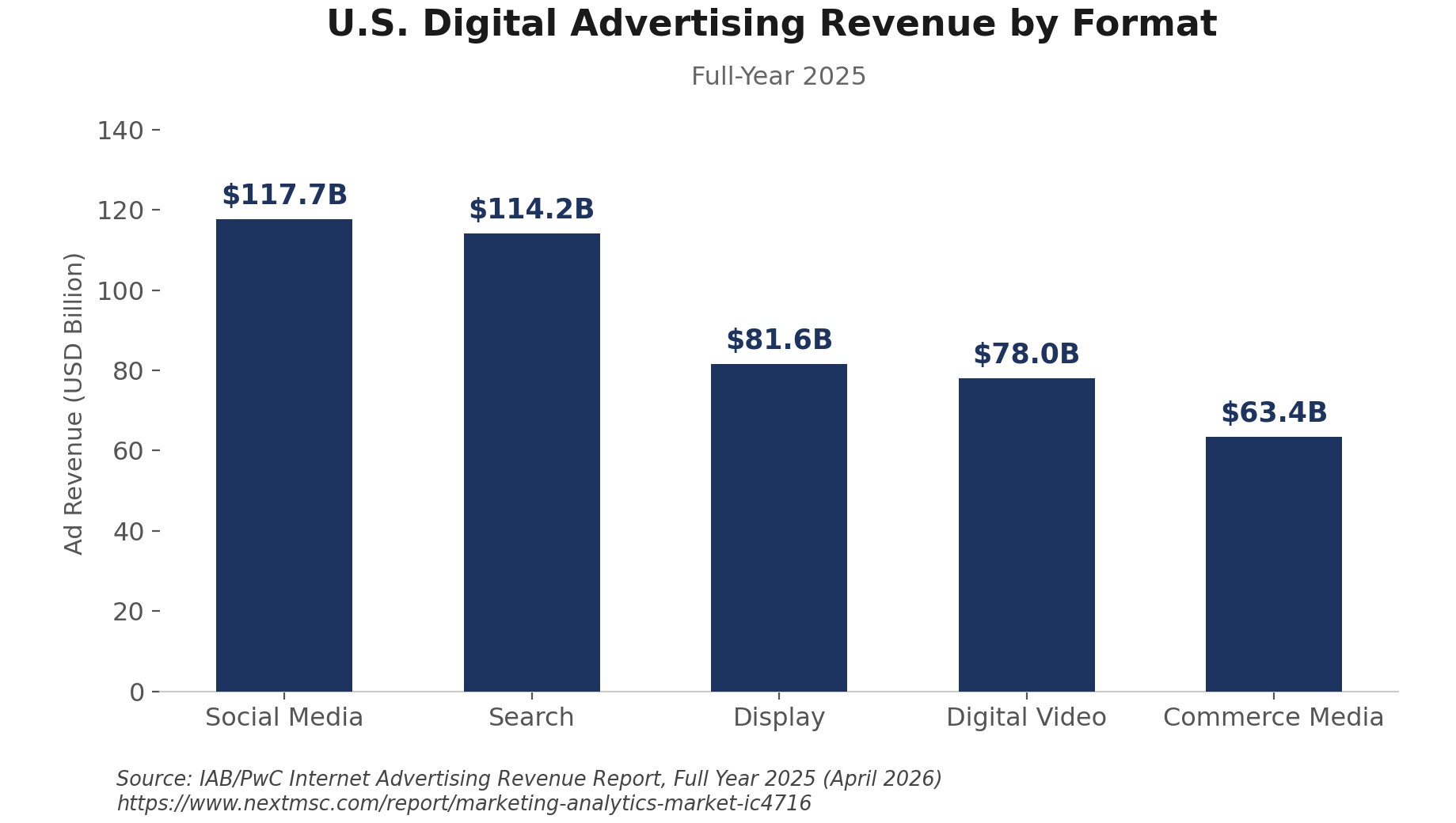
Social media and search remain the two largest formats by revenue, but digital video and commerce media are growing fastest and each format carries its own measurement quirks, which is precisely why cross-channel marketing analytics platforms exist: a brand running social, search, video, and retail-media campaigns simultaneously cannot reconcile performance using any single platform's native reporting alone.
Cookie deprecation and the sheer scale of multi-format ad spend are forcing marketers toward unified, first-party-data-driven measurement rather than relying on each channel's own reporting.
-
Social media ($117.7B) and search ($114.2B) remain the largest U.S. digital ad formats by revenue in 2025
-
Digital video and commerce media are newer, fast-growing formats that add fresh measurement complexity
-
First-party data, server-side tagging, and modeled conversions are replacing cookie-based tracking across the industry
Industry Leader Moves: How the Biggest Platforms Are Rebuilding Measurement
The past six months show this shift moving from roadmap to shipped product across the market's biggest vendors and the common thread is that measurement is being built into the same platforms marketers already use to plan and execute campaigns, rather than sold as a separate add-on.
Marketing Analytics Industry Leader Moves, 2026
|
Company |
Recent Move |
Date |
|
Adobe Inc. |
Launched Marketing Campaign Analytics and CX Enterprise Coworker (agentic CX orchestration) |
Apr 2026 |
|
Salesforce, Inc. |
Expanded Google Cloud partnership; Tableau analytics now accessible inside Gemini Enterprise via Tableau MCP |
Sep 2026 |
|
Oracle Corporation |
Introduced Fusion Agentic Applications for customer experience (CX) |
Apr 2026 |
|
SAP SE |
Unveiled “Autonomous Marketing & Engagement” vision in SAP Engagement Cloud Q3 2026 release |
Sep 2026 |
|
HubSpot, Inc. |
Rebranded INBOUND to UNBOUND; launched Marketing Studio 2.0 with Campaign, Content and Revenue Agents |
Sep 2026 |
|
Nielsen Consumer LLC |
Accelerated Streaming Content Ratings to daily data delivery, cutting reporting lag by 80% |
Sep 2026 |
|
Kantar Group Limited |
Entered AI partnership with Quilt.AI; launched EvaluateExplorer innovation tool |
Mar 2026 |
|
Similarweb Ltd. |
Published State of Ecommerce 2026 report; expanded AI-agent partnership with Manus |
May–Sep 2026 |
|
Sprinklr, Inc. |
Named a Leader in the 2026 Gartner Magic Quadrant for Social Media Management and Listening |
Jul 2026 |
|
Meltwater N.V. |
Shipped 2026 Mid-Year Release expanding Mira AI assistant and GenAI Lens brand-visibility tools |
May 2026 |
Adobe, Salesforce, and Oracle: Measurement Built Into the Platform
Adobe unified its incrementality-focused Mix Modeler measurement with AI-powered insights into a single Marketing Campaign Analytics experience in April 2026, alongside CX Enterprise Coworker, an agentic layer that draws on Adobe's Real-Time CDP, Journey Optimizer, and Customer Journey Analytics and can operate across outside AI platforms including AWS, Google Cloud, and Microsoft. Salesforce took its own analytics engine, Tableau, and made it directly queryable by AI agents: at Dreamforce 2026 in September, Salesforce and Google Cloud connected Tableau analytics to Google's Gemini Enterprise via a new Tableau MCP integration, while also linking Salesforce's Hyperforce infrastructure to run natively on Google Cloud. Oracle, meanwhile, introduced Fusion Agentic Applications for customer experience in April 2026 AI agents built into Oracle Fusion Cloud Applications that can access unified enterprise data and execute marketing, sales, and service decisions rather than simply report on them.
SAP and HubSpot: Autonomous Marketing Meets a Rebranded Platform
SAP's Q3 2026 Engagement Cloud release introduced what it calls “Autonomous Marketing & Engagement” connecting enterprise data and operational processes so AI can execute personalized campaigns at scale, paired with a generally available AI-assisted content composer. HubSpot made the boldest structural move: after fifteen years, it retired the INBOUND name for UNBOUND, and used its September 2026 conference to launch a rebuilt Marketing Studio 2.0 alongside new Campaign, Content, and Revenue Agents and an AI-first workspace called HubSpot Work all oriented around what HubSpot calls “growth context,” connecting AI outputs to actual CRM data rather than generic prompts.
Nielsen, Kantar, Similarweb, Sprinklr, and Meltwater
The measurement specialists moved on narrower but still material fronts. Nielsen cut its Streaming Content Ratings reporting lag by roughly 80% in September 2026, moving from weekly to daily data delivery. Kantar entered a strategic partnership with Quilt.AI in March 2026, launching EvaluateExplorer to compress innovation-concept testing from months to about a week. Similarweb published its State of Ecommerce 2026 report in September and expanded an AI-agent partnership with Manus, deepening its position as a digital-intelligence layer for AI-mediated shopping journeys. Sprinklr was named a Leader in the 2026 Gartner Magic Quadrant for Social Media Management and Listening in July, placing furthest on completeness of vision among rated vendors. And Meltwater's May 2026 Mid-Year Release embedded its Mira AI assistant which has now handled more than 1.3 million customer prompts across every step of its media, social, and consumer-intelligence workflows, alongside a GenAI Lens tool for tracking brand visibility inside AI-generated answers.
Vendor investment has shifted from stand-alone analytics dashboards toward AI agents embedded inside the CX and CRM platforms marketers already use, with measurement increasingly framed as proof that an agent's action worked, not just a report on what happened.
-
Adobe, Salesforce, and Oracle each shipped agentic CX capabilities tied directly to their analytics stacks in 2026
-
HubSpot's INBOUND-to-UNBOUND rebrand signals a platform-wide shift toward connected, agent-driven “growth context”
-
Nielsen, Kantar, Similarweb, Sprinklr, and Meltwater are each embedding AI more deeply into measurement, testing, and brand-visibility tools
Where AI Adoption in Marketing Stands Today
Vendor roadmaps are only half the picture; the other half is how fast marketing teams are actually adopting these tools.
AI Adoption Benchmarks in Marketing, 2026
|
AI-in-Marketing Benchmark (2026) |
Value |
|
Organizations currently using AI in marketing |
64% |
|
Marketers extensively using AI for data analysis and automated reporting |
32.96% |
|
AI users who already use an AI-powered shopping assistant to make purchase decisions |
24% |
Those numbers point to a gap worth naming: roughly two-thirds of organizations report using AI in marketing at all, but only about a third say they're using it extensively for the analytical work data analysis and automated reporting that marketing analytics platforms are built to do. That gap is exactly where the customer experience management platforms discussed above are positioning themselves: as the connective layer that turns broad AI adoption into measurable, campaign-level analytical use, including AI-powered website engagement.
Marketing teams have broadly adopted AI, but a smaller share is using it for the deep analytical and reporting work marketing analytics platforms specialize in a gap vendors are racing to close.
-
64% of organizations report using AI in marketing in some form
-
Only about a third extensively use AI specifically for data analysis and automated reporting
-
Nearly a quarter of AI users already let an AI assistant help make purchase decisions, adding new, non-cookie-based journeys for analytics platforms to track
Future Outlook
The next phase of this market looks less like “build a better dashboard” and more like “prove an AI agent's action produced the result.” As Adobe's, Salesforce's, Oracle's, and SAP's agentic CX tools move from launch to production use, marketing analytics platforms will need to attribute outcomes not just to a channel or a campaign, but to a specific agent decision a harder measurement problem than anything cookie-based attribution was built to solve. Vendors that can connect generative-AI content production to measurable performance, rather than treating them as separate systems, are best positioned for the next stage of growth; NMSC's Generative AI Market research tracks the content side of that convergence in more depth.
Expect consolidation to continue as platform vendors acquire specialist measurement and attribution capabilities rather than build them from scratch, and expect the vendors named above to keep narrowing the gap between “AI adoption” and “AI-driven analytical rigor” that today's adoption data still shows.
Marketing analytics is moving from measuring channels and campaigns to measuring individual AI agent decisions, pushing platform vendors to fuse generative content, agentic execution, and attribution into a single measurable system.
-
Attribution is expanding from channel- and campaign-level to individual agent-decision-level measurement
-
Generative-AI content tools and marketing analytics are converging into unified platforms
-
Consolidation via acquisition of specialist measurement vendors is likely to continue
Conclusion
The vendors winning budget in this market are the ones proving their platforms drive outcomes, not just displaying data about them. With the global Marketing Analytics Market on track to more than triple by 2035, and with cookie deprecation, agentic CX platforms, and uneven AI adoption all converging on the same demand for provable performance, marketing analytics has moved from a reporting layer to a purchasing criterion in its own right.
For a detailed breakdown of market sizing, segmentation, and competitive positioning: Download Free Sample.
About the Author
 Sanyukta Deb
— Sanyukta Deb is Digital Marketing Team Lead at Next Move Strategy Consulting, where she has led content strategy and technical SEO for the firm's B2B market research publications for over 2 years. Her editorial process translates NextMSC's primary and secondary research — spanning technology, industrial, and consumer sectors — into commercial narratives, backed by search-intent, keyword, and competitive analysis. She brings 5 years of overall experience in digital marketing and content strategy.
Sanyukta Deb
— Sanyukta Deb is Digital Marketing Team Lead at Next Move Strategy Consulting, where she has led content strategy and technical SEO for the firm's B2B market research publications for over 2 years. Her editorial process translates NextMSC's primary and secondary research — spanning technology, industrial, and consumer sectors — into commercial narratives, backed by search-intent, keyword, and competitive analysis. She brings 5 years of overall experience in digital marketing and content strategy.
About the Reviewer
 Debashree Dey
— Debashree Dey is Assistant Manager at Next Move Strategy Consulting, where she supports cross-vertical market content and communications across diverse industries for 6 years. Her professional background includes senior content writing, communications, and published manuscript authorship, with experience developing audience-focused business narratives and maintaining clear, consistent messaging. Her role supports research-led content development and editorial quality across NextMSC publications.
Debashree Dey
— Debashree Dey is Assistant Manager at Next Move Strategy Consulting, where she supports cross-vertical market content and communications across diverse industries for 6 years. Her professional background includes senior content writing, communications, and published manuscript authorship, with experience developing audience-focused business narratives and maintaining clear, consistent messaging. Her role supports research-led content development and editorial quality across NextMSC publications.








Add Comment