Middle East Electric Vehicle (EV) Charging Market by Type of Charger (AC Chargers, and DC Chargers), by Charging Speed (Level 1, Level 2, and Level 3), by Connector Type (Type 1, Type 2, CCS, CHAdeMO and Others), by Installation (Fixed, and Portable), and by End User (Commercial, and Residential) – Opportunity Analysis and Industry Forecast 2023–2030.
Industry: Automotive & Transportation | Latest Edition: August 13, 2026 | No of Pages: 412 | No. of Tables: 208 | No. of Figures: 196 | Format: PDF | Report Code: AT875
What Is the Middle East EV Charging Market Size?
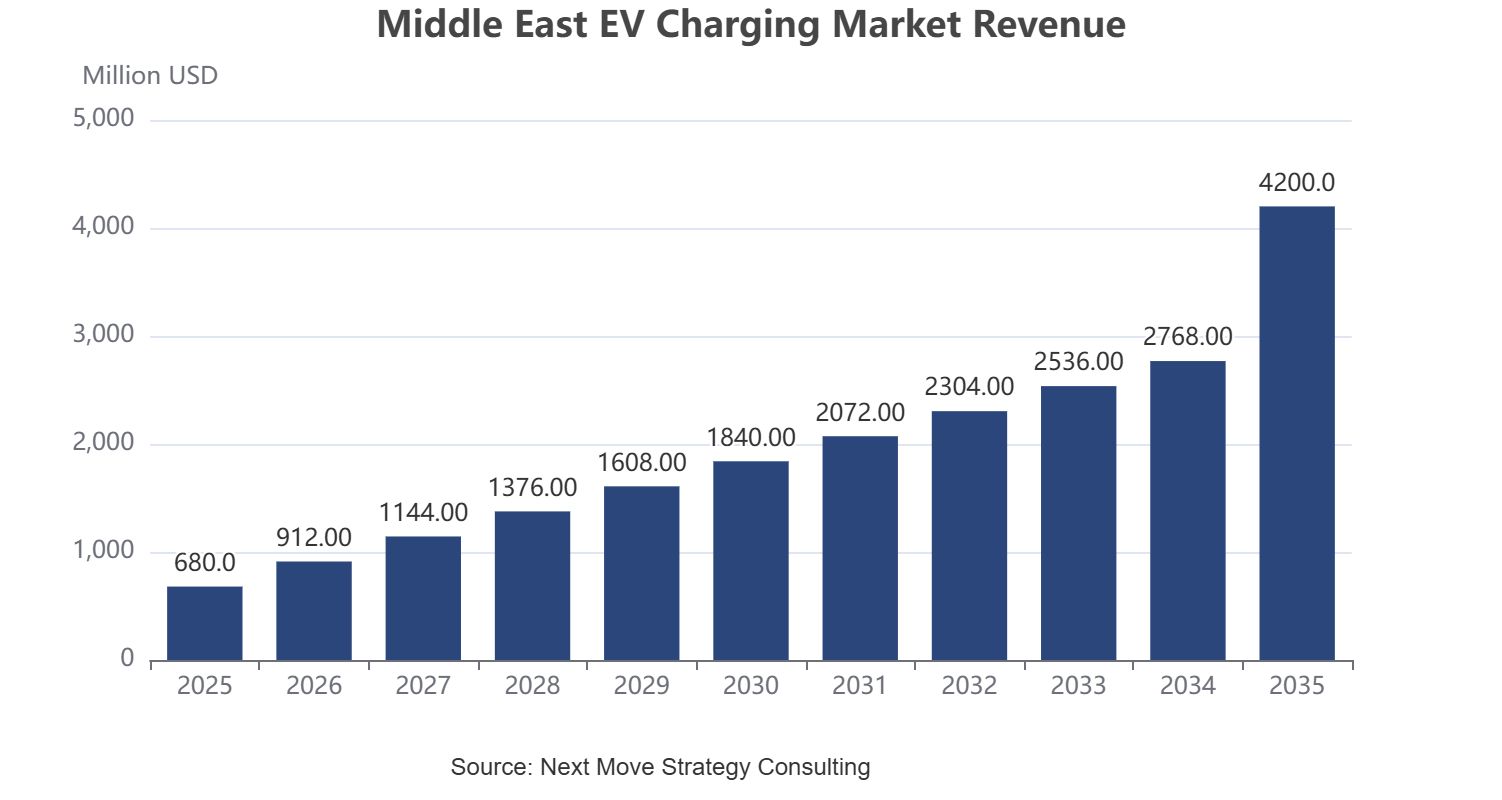
The Middle East EV Charging Market size was valued at USD 680.0 Million in 2025 and is estimated at USD 820.0 Million in 2026, forecast to reach USD 4,200.0 Million by 2035, expanding at a 19.90% CAGR between 2026 and 2035. AC chargers dominate all other charger types with approximately 54% share.
We observed that growth is anchored in rapidly expanding public DC fast-charging network rollouts across key Gulf markets alongside national electric-vehicle adoption targets shaping regional charging infrastructure investment through 2035.
|
Key Takeaways |
|
By Type of Charger: AC Chargers held the largest share of approximately 54% (USD 370.0 Million) in 2025; Wireless Chargers is the fastest-growing sub-segment at 25.4% CAGR from 2026–2035. |
|
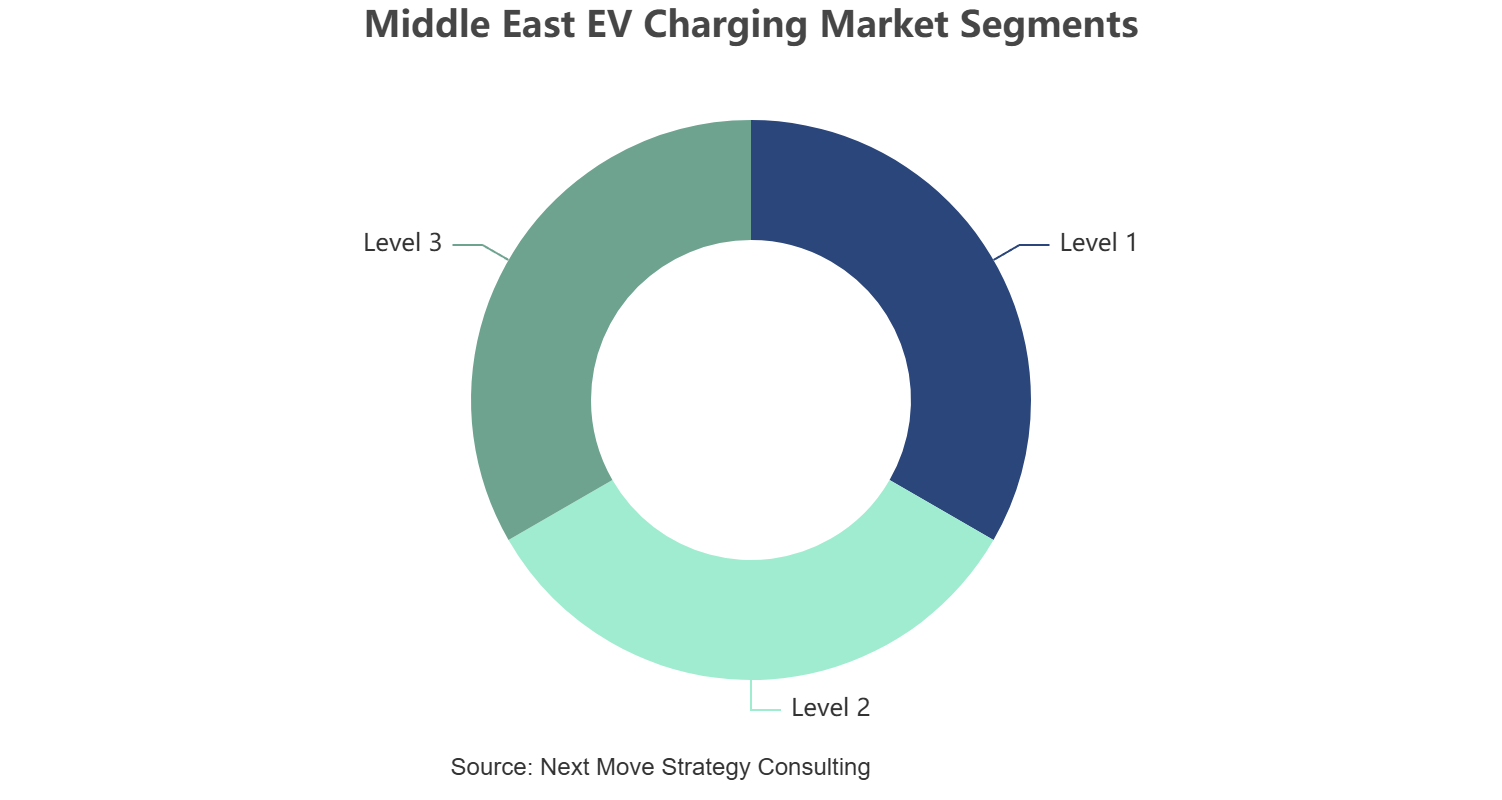
By Charging Speed: Level 2 held the largest share of approximately 46% (USD 310.0 Million) in 2025; Level 3 is the fastest-growing sub-segment at 25.2% CAGR from 2026–2035. |
|
By End User: Commercial held the largest share of approximately 71% (USD 480.0 Million) in 2025; Commercial is also the fastest-growing sub-segment at 21.2% CAGR from 2026–2035. |
Market Opportunity: The Middle East EV charging market is expected to create an absolute dollar opportunity of USD 3,380.0 Million between 2026 and 2035, presenting significant investment potential across the DC fast-charging, commercial network operator, and wireless charging value chain.
According to Next Move Strategy Consulting analysis, national utility operators across the Gulf Cooperation Council are increasingly co-investing with private charge point operators to accelerate highway and urban DC fast-charging corridor buildout, a shift that favors regionally established electrical infrastructure suppliers over pure-play charging hardware importers as public-private infrastructure partnerships scale through 2035.
What Does the Middle East EV Charging Market Encompass?
The Middle East EV charging market report covers AC, DC, and wireless charging equipment, along with associated connector standards and installation formats, deployed across commercial and residential electric-vehicle charging infrastructure in across the Middle East. Our assessment indicates that the market has evolved from limited pilot charging installations tied to luxury electric-vehicle imports toward government-backed national charging network programs supporting mainstream electric-vehicle adoption across the region.
Regulatory frameworks such as the regional charging infrastructure standards and grid-connection guidelines shape charger certification and grid-connection requirements, while national electric-vehicle adoption targets tied to Vision 2030-linked economic diversification programs continue to expand public charging network mandates. We observed that technology adoption is shifting toward DC fast-charging corridors along intercity highways. Based on research conducted by Next Move Strategy Consulting, we found that this structural shift, combined with growing commercial fleet electrification, is redefining sourcing criteria across the market report on this market.
|
Parameter |
Details |
|
Market Size in 2025 |
USD 680.0 Million |
|
Market Size in 2026 |
USD 820.0 Million |
|
Revenue Forecast in 2035 |
USD 4,200.0 Million |
|
Growth Rate |
CAGR of 19.90% from 2026 to 2035 |
|
Analysis Period |
2025–2035 |
|
Base Year Considered |
2025 |
|
Forecast Period |
2026–2035 |
|
Market Size Estimation |
Revenue (USD Million) |
|
Companies Profiled |
15 |
|
Market Share |
Available for Top 10 Companies |
Key Emerging Trends
Based on research conducted by Next Move Strategy Consulting, we found that four structural trends are reshaping product development, sourcing, and stakeholder engagement across the industry.
How Is DC Fast-Charging Corridor Development Transforming Regional Connectivity?
Intercity DC fast-charging corridors that connect major Gulf cities are replacing isolated urban charging installations as national utility operators expand highway network coverage. We observed that ABB Industries LLC's high-power DC charging deployments, expanded across additional Gulf highway locations in 2025, continue to anchor corridor connectivity that competitors are replicating across national charging programs. Governments are funding these corridors to reduce range anxiety, while charge point operators retool site-selection strategies to support long-distance travel infrastructure.
Why Is Commercial Fleet Electrification Accelerating Charging Demand?
Commercial fleet electrification programs covering taxis, ride-hailing vehicles, and logistics fleets are gaining traction as government mandates push operators toward zero-emission vehicle transitions. Our findings suggest that fleet operators increasingly specify dedicated depot-based DC charging installations to support high-utilization vehicle turnaround. ChargePoint Inc's fleet-focused charging management platform, expanded across additional regional deployments in 2025, exemplifies this direction within the commercial end-user category.
How Is Renewable Energy Integration Reshaping Charging Infrastructure Design?
Solar-integrated charging stations that pair on-site photovoltaic generation with grid-connected charging are expanding beyond standalone diesel-backed installations into renewable-linked infrastructure. We observed that Siemens Middle East Limited's grid-integrated charging solutions, broadened through regional utility partnerships in 2025, continue to anchor renewable-linked deployment models that competitors are replicating across national charging tenders. This trend is elevating demand for smart-grid-compatible charging hardware among utility-scale infrastructure developers.
What Role Does Charging Network Digitization Play in User Adoption?
Mobile-app-based payment and reservation systems that let drivers locate, reserve, and pay for charging sessions are emerging as a critical adoption lever across the region's growing public charging network. Our analysis shows that operators in the AC and DC charger categories are pairing hardware rollouts with unified payment platforms to reduce user friction. Huawei Tech Investment Middle East FZ LLC's digital charging management platform, expanded through 2025, exemplifies this direction within the commercial public charging category.
PESTEL Analysis of the Middle East EV Charging Market
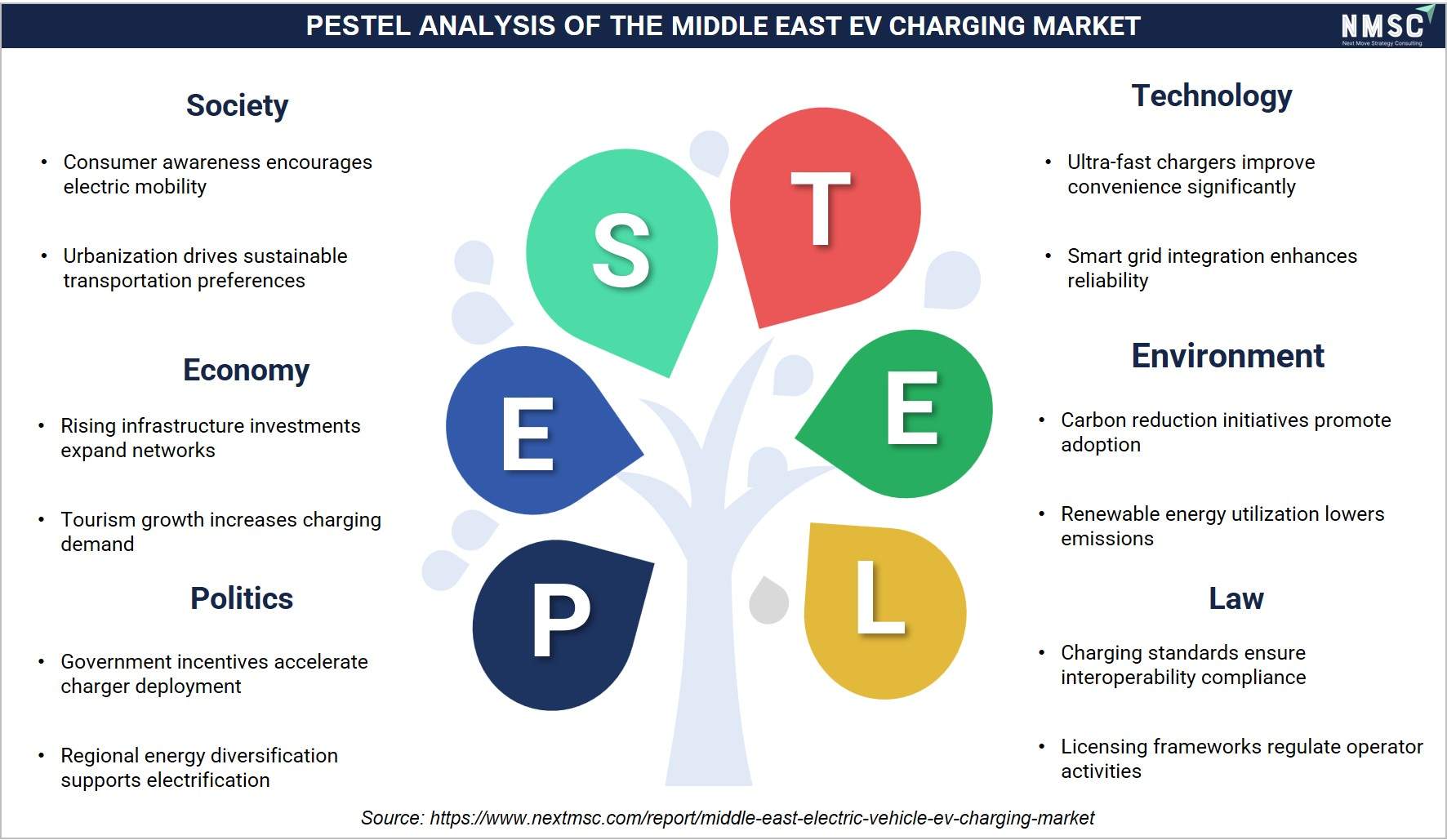
NMSC's analysis indicates that growing consumer awareness, rapid urbanization, and government incentives drive expansion in the Middle East EV Charging Market. Furthermore, ultra-fast charging technology and smart grid integration enhance overall network reliability. Concurrently, infrastructure investments and tourism growth boost charging demand, while carbon reduction initiatives, renewable energy adoption, standardized charging policies, and operator licensing frameworks enforce regulatory compliance and sustainable regional electrification.
Growth Drivers and Restraints
|
Factors |
Type |
(+/−) % Impact on CAGR |
Geographic Relevance |
Impact Timeline |
|
National electric-vehicle adoption targets tied to Vision 2030-linked programs |
Driver |
+4.8% |
GCC markets |
2026-2035 |
|
Expanding DC fast-charging highway corridor investment |
Driver |
+3.6% |
GCC markets |
2026-2035 |
|
Growing commercial fleet electrification mandates |
Driver |
+2.8% |
GCC markets |
2026-2035 |
|
Rising renewable energy grid integration for charging infrastructure |
Driver |
+1.9% |
GCC markets |
2026-2035 |
|
Expanding electric-vehicle imports and local assembly programs |
Driver |
+1.4% |
Turkey and select Middle East markets |
2026-2035 |
|
Growing public-private charging infrastructure partnerships |
Driver |
+1.0% |
GCC markets |
2026-2032 |
|
Limited grid capacity in some regional markets |
Restraint |
-1.8% |
select regional markets |
2026-2035 |
|
High upfront capital cost of DC fast-charging infrastructure |
Restraint |
-1.2% |
select regional markets |
2026-2035 |
|
Fragmented connector-standard adoption across countries |
Restraint |
-0.7% |
Regional |
2026-2032 |
What Is the Primary Growth Driver of the Middle East EV Charging Market?
National electric-vehicle adoption targets tied to Vision 2030-linked economic diversification programs are the primary driver of the market. We observed that this policy-supported adoption curve, reinforced by growing electric-vehicle import volumes, continues to anchor baseline charging-equipment procurement across Gulf Cooperation Council markets.
How Is DC Fast-Charging Corridor Investment Driving Market Growth?
Expanding DC fast-charging highway corridor investment is accelerating charging-infrastructure deployment across intercity travel routes connecting major Gulf metropolitan areas. Regional public charging authorities continue to report expanding public charging station coverage under national electric-vehicle infrastructure programs. Our assessment indicates that this infrastructure-investment trend, combined with growing utility-operator co-investment models, is compressing deployment timelines for high-power DC charging corridors.
What Is Restraining Middle East EV Charging Market Expansion?
Limited grid capacity in some regional markets restrains DC fast-charging deployment relative to Gulf Cooperation Council markets. We found that charge point operators prioritizing lower-power AC installations face fewer grid-interconnection barriers than DC fast-charging deployments, particularly across markets with constrained electricity-generation capacity.
Segmentation Analysis
Segment Sizing: By Type of Charger
|
Segment |
2025 (USD) |
2035 (USD) |
CAGR% (2026–2035) |
|
AC Chargers |
USD 370.0 Million |
USD 1,760.0 Million |
16.6% |
|
DC Chargers |
USD 280.0 Million |
USD 2,180.0 Million |
22.8% |
|
Wireless Chargers |
USD 30.0 Million |
USD 250.0 Million |
25.4% |
|
Total |
USD 680.0 Million |
USD 4,200.0 Million |
19.90% |
Which Charger Type Dominates the Middle East EV Charging Market?
AC Chargers led the market with USD 370.0 Million in 2025, supported by widespread residential and workplace charger installations tied to overnight and daytime charging use cases across the region. We observed that Wireless Chargers is the fastest-growing charger type, expanding at a 25.4% CAGR from 2026 to 2035, albeit from a small base, as pilot deployments of inductive charging expand across select premium residential and fleet-depot applications.
Segment Sizing: By Charging Speed
|
Segment |
2025 (USD) |
2035 (USD) |
CAGR% (2026–2035) |
|
Level 1 |
USD 120.0 Million |
USD 380.0 Million |
11.0% |
|
Level 2 |
USD 310.0 Million |
USD 1,600.0 Million |
17.4% |
|
Level 3 |
USD 250.0 Million |
USD 2,230.0 Million |
25.2% |
|
Total |
USD 680.0 Million |
USD 4,200.0 Million |
19.90% |
Which Charging Speed Leads Middle East EV Charging Market Demand?
Level 2 remained the leading charging speed within the market, valued at USD 310.0 Million in 2025 on sustained residential and commercial workplace charging installations. Our findings suggest that Level 3 is the fastest-growing charging speed, registering a 25.2% CAGR from 2026 to 2035, as national highway corridor programs and commercial fleet depots increasingly specify high-power DC fast-charging equipment to minimize vehicle downtime.
Segment Sizing: By End User
|
Segment |
2025 (USD) |
2035 (USD) |
CAGR% (2026–2035) |
|
Commercial |
USD 480.0 Million |
USD 3,280.0 Million |
21.2% |
|
Residential |
USD 200.0 Million |
USD 920.0 Million |
16.3% |
|
Total |
USD 680.0 Million |
USD 4,200.0 Million |
19.90% |
Which End User Segment Is Most Significant in the Middle East EV Charging Market?
Commercial remained the largest end-user segment, reaching USD 480.0 Million in 2025 on sustained public charging network and fleet-depot installation activity. Based on research conducted by Next Move Strategy Consulting, we found that Commercial is also the fastest-growing end-user segment at a 21.2% CAGR from 2026 to 2035, reflecting accelerating public infrastructure investment and commercial fleet electrification programs across the region.
Growth Opportunities
Our analysis shows that three forward-looking opportunities stand out for stakeholders positioning within the Middle East EV charging market over the 2026-2035 forecast period.
How Can Solar-Integrated Charging Hubs Unlock Value for Infrastructure Developers?
Solar-integrated charging hubs that pair on-site photovoltaic generation with DC fast-charging present a whitespace opportunity for infrastructure developers in high-solar-irradiance Gulf markets. Companies that build renewable-linked charging stations stand to capture utility co-investment funding within the DC chargers segment as national grid-decarbonization targets expand.
Where Do Underserved African Markets Create New Demand?
Underserved charging infrastructure markets across the broader region represent an underpenetrated opportunity for scalable AC charging deployment. Companies that establish grid-appropriate, lower-power charging networks can secure early-mover positioning, benefiting from expanding electric-vehicle import growth within the residential end-user segment across price-sensitive African markets.
How Can Fleet-Depot Charging Management Platforms Benefit Commercial Operators?
Commercial fleet operators seeking centralized depot-charging management create an opportunity for software-integrated charging platform providers. Early movers that secure fleet-operator partnerships can differentiate with logistics and ride-hailing companies pursuing scalable depot electrification within the commercial end-user segment.
Ecosystem Analysis of the Middle East EV Charging Market
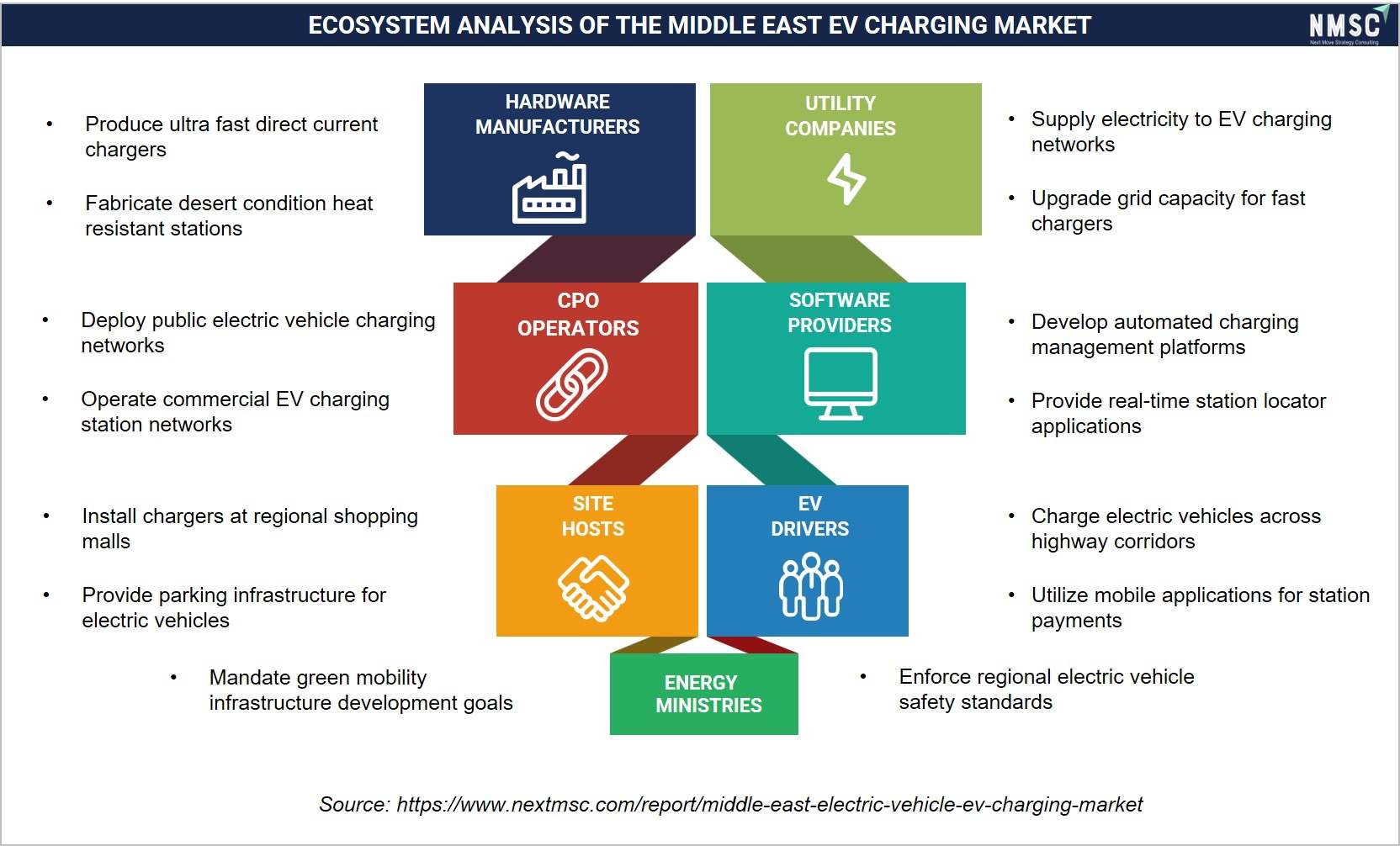
Based on research conducted by NMSC, we found that the Middle East EV Charging Market functions within an ecosystem uniting hardware manufacturers, utility companies, CPO operators, and software providers. Site hosts integrate charging infrastructure at shopping malls, allowing EV drivers to charge seamlessly along highway corridors. Ultimately, energy ministries mandate green mobility development goals and enforce regional vehicle safety standards, ensuring reliable grid expansion and safe deployment.
Competitive Landscape
We observed that the Middle East EV charging market remains moderately fragmented, with large global electrical-equipment manufacturers, regional Middle East subsidiaries of automotive and technology firms, and specialized charging-hardware developers all competing for national tender and commercial network operator contracts.
|
Dimension |
Details |
|
Market Structure |
Moderately fragmented, with the Top 10 companies accounting for a defined share of Industry revenue |
|
Innovation Focus |
DC fast-charging corridor deployment, grid-integrated renewable charging, and digital payment platforms |
|
M&A Activity |
Regional expansion through Middle East subsidiary formation and local distribution partnerships |
How Do Companies Compete Within the Middle East EV Charging Market?
Companies compete primarily on national tender qualification, grid-certification compliance, and regional service-network depth across Gulf Cooperation Council and broader Middle East and Africa markets. Our analysis shows that suppliers increasingly differentiate through localized Middle East subsidiary presence rather than pure export relationships, as government procurement programs favor vendors with regional installation and maintenance capability.
Which Competitive Archetypes Dominate the Middle East EV Charging Market?
Three archetypes dominate: large global electrical-equipment manufacturers with Middle East subsidiaries such as Schneider Electric FZE and ABB Industries LLC; automotive and technology firms with regional branches such as Tesla Motors Netherlands BV Dubai Branch and Huawei Tech Investment Middle East FZ LLC; and specialized charging-hardware developers such as XCHG Limited and ZEROVA Technologies. Each archetype leverages distinct distribution channels, from national utility tender relationships to direct commercial network operator partnerships.
What Innovation and Differentiation Strategies Are Companies Pursuing?
Companies are pursuing DC fast-charging corridor deployment, grid-integrated renewable charging solutions, and digital payment platform integration as core differentiation strategies. We found that Industry leaders are also investing in localized Middle East manufacturing and assembly partnerships to reduce import lead times and strengthen national tender competitiveness.
What M&A Activity Is Shaping the Competitive Landscape?
M&A activity is concentrated on establishing dedicated Middle East subsidiary entities and forming local distribution partnerships rather than large-scale acquisitions. Our assessment indicates that this regional-expansion trend is expected to continue as global suppliers seek closer proximity to national utility procurement processes and grid-certification authorities.
Key Market Players
Our findings suggest that the following 15 companies represent the leading verified providers active in the Middle East EV charging market as of 2026, ranked in the order supplied for this report.
-
ABB Industries LLC
-
Siemens Middle East Limited
-
Delta Electronics MEA DMCC
-
Tesla Motors Netherlands BV Dubai Branch
-
Huawei Tech Investment Middle East FZ LLC
-
Eaton FZE
-
XCHG Limited
-
EVB Digital Energy
-
ZEROVA Technologies
-
Wanbang Digital Energy Co Ltd
-
Blink Charging Co
-
Leviton Middle East FZE
-
Tritium Technologies Singapore Pte Ltd
Latest Developments
We observed that recent network expansions and partnership announcements reflect the industry's continued shift toward DC fast-charging corridor buildout and localized regional presence.
|
Date |
Event |
|
November 2025 |
Schneider Electric partnered with Salik and Vcharge to deploy more than 1,800 EV charging points across the UAE. The collaboration integrates Schneider's charging technology with digital payment services and nationwide infrastructure deployment to accelerate public EV charging accessibility. |
|
February 2025 |
ABB partnered with Red Sea Global to deploy more than 1,200 AC and DC EV chargers across The Red Sea and AMAALA destinations in Saudi Arabia. The project includes locally manufactured charging pedestals and supports one of the region's largest charging infrastructure rollouts. |
Expert Insights
 “By 2026/2027, you’re going to see a massive surge in the sales of electric vehicles.”
— Kalyana Sivagnanam, CEO, Petromin Group
Statement made during an interview with Arab News at the EV Auto Show Riyadh 2024 while discussing the outlook for electric vehicle adoption driven by declining battery costs and the continued expansion of charging infrastructure.
Market Interpretation
The statement reflects the strong growth outlook for electric mobility in the Middle East, supported by improving charging infrastructure, declining battery costs, and government-led electrification initiatives. As electric vehicle adoption accelerates across the region, demand for reliable and accessible charging infrastructure is expected to increase significantly. This is encouraging investments in public and private charging networks, fast-charging technologies, charging management platforms, and integrated EV charging services to support the expanding electric vehicle ecosystem and facilitate the region's transition toward sustainable transportation.
Investment Opportunities
What Capital Inflows Are Targeting the Middle East EV Charging Market?
Capital inflows continue to target DC fast-charging corridor development and grid-integrated renewable charging infrastructure, with national utility co-investment programs attracting sustained interest. Our assessment indicates that investors favor companies demonstrating measurable national tender wins and grid-certification compliance over pure hardware-shipment metrics.
How Is Infrastructure Investment Shaping Market Expansion?
National highway corridor and urban charging network infrastructure investment continues to expand deployment coverage, supporting the 25.2% CAGR projected for Level 3 charging through 2035. We found that companies are prioritizing regional service-center and installation-partner expansion to serve growing Gulf Cooperation Council and broader African market demand.
What ESG Considerations Are Relevant to Middle East EV Charging Investment?
Environmental, Social, and Governance considerations increasingly favor suppliers integrating solar and renewable energy sources into charging infrastructure while supporting national grid-decarbonization targets. Our analysis shows that institutional investors are prioritizing companies with transparent renewable-integration and grid-capacity-planning disclosures aligned with regional sustainability frameworks.
Key Benefits for Stakeholders
How Does This Report Benefit Infrastructure and Industry Leaders?
Infrastructure and industry leaders gain access to verified segmentation, regional sizing, and competitive benchmarking that inform network-deployment and technology investment decisions. Our analysis, data, and forecasts help leaders prioritize DC fast-charging and grid-integration investments aligned with projected segment growth.
How Does This Report Benefit Investors and Financial Analysts?
Investors and financial analysts benefit from validated market-sizing, CAGR methodology, and company-level competitive positioning that support capital-allocation and valuation decisions. Our findings suggest that segment-level growth differentials, particularly in Level 3 charging and Commercial end use, offer actionable signals for portfolio construction.
How Does This Report Benefit Utility and Fleet Operator Product Teams?
Utility and fleet operator product teams gain strategic insight into emerging trends, competitive archetypes, and regional demand patterns that inform network-planning and procurement prioritization. We observed that this analysis supports go-to-market planning for grid-integrated charging and fleet-depot partnerships across target country markets.
Key Market Segments
By Type of Charger
-
AC Chargers
-
Mode 1
-
Mode 2
-
Mode 3
-
-
DC Chargers
-
Wireless Chargers
-
Static Wireless Charging
-
Dynamic Wireless Charging
-
By Charging Speed
-
Level 1
-
Level 2
-
Level 3
By Connector Type
-
Type 1
-
Type 2
-
CCS
-
CHAdeMO
-
GB
-
NACS
-
Others
By Installation
-
Fixed
-
Portable
By End User
-
Commercial
-
Commercial Public EV Charging Station
-
Commercial Private EV Charging Stations
-
-
Residential
-
Private Homes
-
Apartments
-
Conclusion and Recommendations
What Is the Long-Term Outlook for the Middle East EV Charging Market?
The long-term outlook remains strongly positive, with the market projected to expand from USD 820.0 Million in 2026 to USD 4,200.0 Million by 2035 at a 19.90% CAGR. Our assessment indicates that sustained national EV infrastructure investment and expanding DC fast-charging corridor buildout will anchor growth across the Middle East through the forecast horizon.
What Strategic Positioning Should Companies Pursue?
Companies should prioritize national tender qualification and localized Middle East subsidiary presence to differentiate within an increasingly government-procurement-driven landscape. Our findings suggest that companies combining grid-certification compliance with regional installation capability will be best positioned to retain national infrastructure program contracts.
How Attractive Is the Market for New Investment?
The market presents a highly attractive investment case, supported by a USD 3,380.0 Million absolute dollar opportunity between 2026 and 2035 and above-average growth in the Level 3 charging segment. We found that investment attractiveness is highest for companies combining DC fast-charging hardware capability with grid-integration and renewable-energy partnerships.
What Market Shifts and Key Risks Should Stakeholders Monitor?
Stakeholders should monitor limited grid capacity in select regional markets, high upfront DC fast-charging capital costs, and fragmented connector-standard adoption as key risks. Our analysis shows that companies unable to navigate national grid-certification requirements risk losing tender competitiveness to regionally established suppliers with stronger utility relationships.
What Are the Key Growth Pathways for the Market?
Key growth pathways include expanding DC fast-charging highway corridors, scaling solar-integrated charging hub deployment, and deepening commercial fleet-depot electrification across the region. Next Move Strategy Consulting's analysis indicates that companies pursuing these pathways while maintaining strong national tender relationships will be best positioned to capture the market's projected growth through 2035.
About the Author
 Saista Faiyaz
— Saista Faiyaz is Research Associate at Next Move Strategy Consulting, where she has covered consumer markets and healthcare technologies for 3 years. Her work includes primary interview review, secondary-source validation, market sizing, and structured analysis of company and industry data. She supports research by comparing evidence across sources, organizing findings into market narratives, and documenting assumptions used in analysis. Her scope includes cross-market benchmarking, and reports.
Saista Faiyaz
— Saista Faiyaz is Research Associate at Next Move Strategy Consulting, where she has covered consumer markets and healthcare technologies for 3 years. Her work includes primary interview review, secondary-source validation, market sizing, and structured analysis of company and industry data. She supports research by comparing evidence across sources, organizing findings into market narratives, and documenting assumptions used in analysis. Her scope includes cross-market benchmarking, and reports.
About the Reviewer
 Supradip Baul
— Supradip Baul is an accomplished business consultant and strategist with over a decade of rich experience in market intelligence, strategy, technology, and business transformation. His work has included rigorous qualitative and quantitative analysis across multiple industries, helping clients shape investment decisions and long-term roadmaps. Earlier in his career, he was associated with Gartner, where he contributed to industry-leading reports and market share analyses. He has worked with leading global companies and holds an MBA with a dual specialization in Marketing and Finance.
Supradip Baul
— Supradip Baul is an accomplished business consultant and strategist with over a decade of rich experience in market intelligence, strategy, technology, and business transformation. His work has included rigorous qualitative and quantitative analysis across multiple industries, helping clients shape investment decisions and long-term roadmaps. Earlier in his career, he was associated with Gartner, where he contributed to industry-leading reports and market share analyses. He has worked with leading global companies and holds an MBA with a dual specialization in Marketing and Finance.
At Next Move Strategy Consulting, we understand that insightful market research is the cornerstone of successful business decisions. That's why we employ a robust and multifaceted approach, combining various methodologies to deliver the most accurate and actionable data for our clients.

Research Landscape
We navigate the world of research with two primary approaches:
Qualitative Approach
Our qualitative research methodologies involve immersive techniques such as in-depth interviews, focus groups, and observational studies. By engaging directly with individuals and stakeholders, we uncover valuable insights that quantitative data alone may overlook.

Quantitative Research
In tandem with qualitative methodologies, NMSC leverages the power of Quantitative Research to provide a robust foundation of numerical insights. Through systematic data collection and analysis, we quantify patterns, preferences, and market trends, offering a comprehensive view of the business landscape.
Our quantitative research approach employs diverse tools, including surveys, experiments, and statistical modelling. These methodologies enable us to gather data from a large and representative sample, ensuring the statistical significance of our findings. By employing structured questionnaires and standardized data collection methods, we guarantee the reliability and validity of the information we present to our clients.
Quantitative research is particularly effective in measuring the prevalence of trends, assessing market size, and gauging the impact of various factors on consumer behavior. The numerical precision attained through this approach equips our clients with actionable insights, facilitating data-driven decision-making and strategy formulation.


Our Specialized Toolbox for Industry-Specific Market Research
We deploy a specialized arsenal of techniques tailored to meet your unique requirements. Here's a glimpse into our comprehensive toolbox:

Information Procurement
The stage entails acquiring market data or relevant information through various sources and methodologies.


Market Research Approach
We utilize both top-down and bottom-up approaches in market research analysis to achieve a comprehensive understanding of the market dynamics, leveraging the broad perspective of industry trends and macroeconomic factors alongside detailed insights from specific segments and individual companies.

Porters Five Forces Analysis
We conduct Porter's Five Forces analysis to evaluate the competitive landscape of an industry, providing us with insights into factors that affect profitability and strategic positioning.

SWOT Analysis

Forecasting
We utilize a forecasting model to predict future consumption by considering parameters like population, economics, regulations, market competition, drivers, constraints, technology, and pricing. We also employ statistical techniques such as multilinear regression, exponential smoothing, moving average, ARIMA, and Monte Carlo simulations for accurate predictions. In econometric forecasting, we analyzed short-term and long-term event impacts, attributing values based on regulatory frameworks, economic factors, and market events.


 Speak to Our Analyst